
The Belgian Shepherd Malinois is a phenomenon today. Videos on social media show super dogs jumping three meters high, walking at heel like magnets, and looking at their handler as the center of the universe. It looks perfect. It looks like the dog everyone wants. But the reality hidden behind the edited video is often much hairier, dirtier, and brutally more demanding on your psyche and time.
A Malinois is not a dog you get just because you like how it looks. It's not a dog you buy to have a buddy for occasional weekend trips while it waits in the apartment during the week for you to come home from work. It is a lifestyle. It is a commitment that will either fit you like a glove and move you forward in life, or grind you down and end with an ad "giving away dog to good hands".
Let's take off the rose-colored glasses and look at the facts. No marketing, no exaggeration, but also no unnecessary scaremongering. Just pure practice that a breeder might not tell you at the first meeting, but which you will find out very quickly when you bring that little biting ball home.
Working Dog: What the Hell Does That Mean?
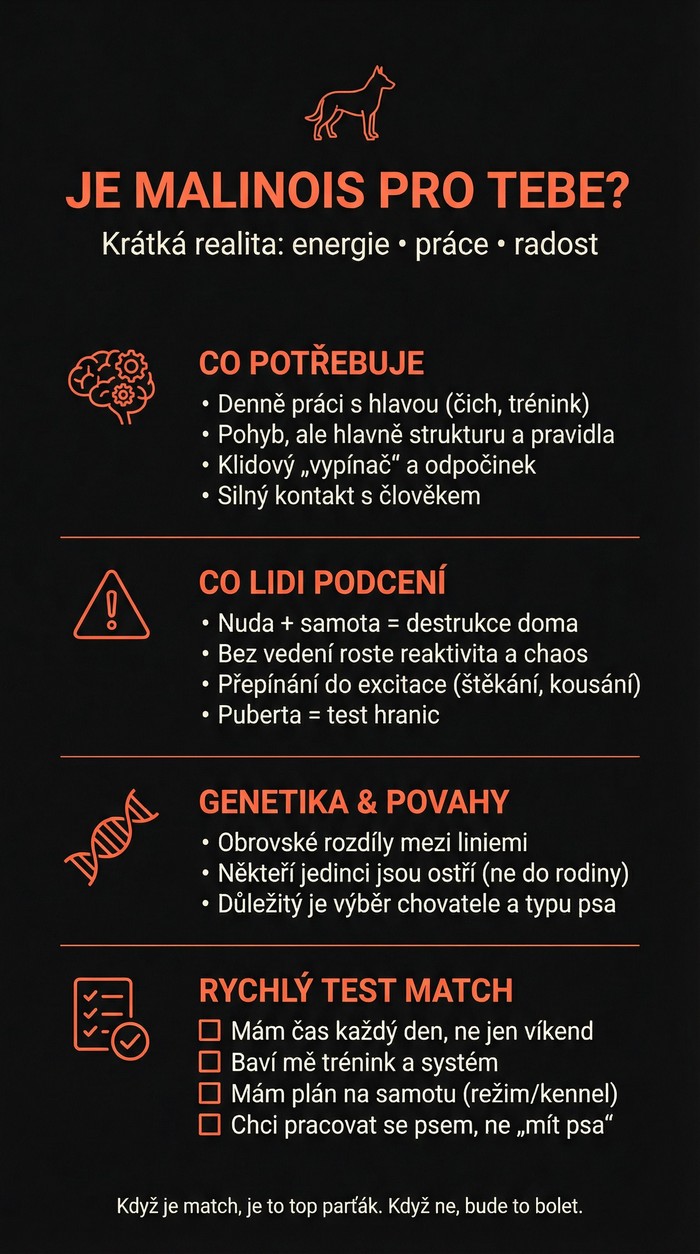
When someone says "working dog," many people imagine they will go running, cycling, or throw a ball in the park with it. That is a huge mistake. The Malinois has been bred for generations to use its head, solve complex situations, cooperate with humans, and be constantly alert. It needs a "job". If you don't give it one, it will find one itself. And believe me, you won't like its ideas.
Its intelligence is a double-edged sword. A "smart dog" doesn't mean it learns obedience by itself. It means it learns incredibly fast – even the bad things. It will learn to open doors, the fridge, unzip backpacks, or manipulate you to get what it wants. Work for a Malinois means structure. It needs clear rules, tasks, and mental stimulation.
Its head gets tired much faster than its legs. If you only physically exhaust a Malinois (bike, endless fetch), you will create a super-athlete at home with Olympian fitness who never gets tired and demands action 24 hours a day. The goal is balance: engage the nose (nosework, tracking), obedience, tricks, self-control. That is the "work" its brain desperately needs to survive.
Energy: Gift and Curse
The Malinois has two basic modes: "ON" and "OFF". The problem is that the "OFF" button is often missing in the basic equipment and you have to install it there laboriously and patiently. These dogs are extremely reactive. They perceive everything faster, stronger, and more intensely than common breeds. This is great for top sports and service training, where milliseconds decide, but extremely demanding for normal family life.
Without training calmness (the art of doing nothing), you will have a dog at home that starts at every rustle, barks at shadows, reacts to every movement in the house, and cannot lie down until it collapses from total exhaustion. Teaching a Malinois to rest is as important as teaching it "sit" or "heel". Maybe even more important. If you don't manage this, you are asking for a reactive nervous wreck that will terrorize you, visitors, and the surroundings under stress.
It often happens that people confuse overstimulation with "pent-up energy". The dog runs, bites, barks, so the owner throws another ball. But that only pours oil on the fire. The dog needs the exact opposite at that moment: calm, darkness, limited space, and sleep.
Solitude and Destruction: Interior Design by Malinois
This is an equation that works with brutal reliability: Boredom + Energy + Solitude = Total Destruction. If you leave an unexercised, untrained Malinois unaccustomed to solitude alone in an apartment without supervision and management, you are risking a lot. And I'm not talking about a chewed slipper.
It's not that it wants to take revenge on you. It's about frustration and the inability to handle its own emotions. Chewed sofas (down to the foam), torn linoleum in the hallway, gnawed door frames, a hole in the drywall, or a completely emptied trash can spread over the bed are not rare with this breed. The solution? Environment management. A crate (kennel) is not a prison, it is a safe haven. The dog learns to switch off there and you have the certainty that when you return, the apartment will be standing and the dog will be safe (because it didn't eat a piece of the couch).
Solitude must be trained gradually, minute by minute. The Malinois is strongly fixated on humans ("velcro dog"). Being without you is not natural for it and it must understand that the owner's departure means "time for sleep", not "time for panic". Separation anxiety is a common problem with them, which can be prevented by the correct procedure from puppyhood.
Genetics: Not All Malinois Are the Same
The Belgian Shepherd has enormous variability in temperaments. It depends on the bloodline and specific breeding. Some are social and open, others are sharp, distrustful, and strongly territorial. Genetics plays a huge role and you can only change it partially with upbringing. If you choose a puppy from a line bred for hard police interventions or top ring sports, and you want it as a pet for children, you are asking for trouble.
Some individuals have a very low arousal threshold and react by biting (or nipping) in moments of stress, but also joy. With small children running, screaming, and making sudden movements, this can trigger the prey drive. This doesn't mean a Malinois can't be in a family – it can, and is often a great protector and best friend to children. But it requires experienced guidance, 100% supervision, set rules, and a dog with a balanced nature. Do not underestimate the choice of breeder and specific puppy. Sometimes it is better to reach for an adult dog where you already know the nature.
Quick Test: Are You a Match?
Before you decide to write to a breeder, try to honestly, really honestly answer the following points. If you hesitate somewhere, stop and think if you really want to go into this.
- Do you have time every day? A Malinois knows no weekends, holidays, or days when you have the flu. It needs your attention and activity daily, in rain and frost.
- Are you consistent? This dog will find every loophole in your rules. What you forbid today must apply tomorrow. If you allow it once, it remembers it forever.
- Do you want to work with the dog? Do you enjoy training, obedience, tracking, or dog sports? If you just want a buddy for the couch and walks, look elsewhere. You will both be unhappy.
- Can you handle its energy? Do you have enough of your own calm and assertiveness to handle a dog that is faster than you and reads your emotions before you realize them yourself?
- Do you have the finances? Quality food is the basis, but count on expenses for training, seminars, equipment (which it will destroy), a crate, and possible damage to the apartment.
- Do you have a management plan? Do you count on a crate? Do you have sitting or walking solved when you are at work for a long time? This dog cannot be alone for 10 hours a day and be bored.
- Are you willing to learn? A Malinois will force you to become a better handler. You will have to study, go to the training ground, listen to criticism, and work on yourself.
Conclusion: Pain or Joy?
When it clicks, life with a Malinois is the best thing in the world. You get a partner who would breathe for you, who reads your thoughts, and with whom every activity is an experience. It is the Ferrari of dogs – fast, powerful, beautiful, but it does not forgive driving errors. That feeling of connection at work is addictive.
When it doesn't click, it is suffering for both sides. The dog is frustrated, you are exhausted, neighbors complain about barking, and it ends with an ad "giving away dog for family reasons" or in a shelter, which is unfortunately full of Malinois. Be honest with yourself. If you go for it, go all in. It's worth it, but it won't be free.
Want more practical tips? Check out…
- History and Origin of the Malinois – How it all started.
- First Year with a Puppy – How to survive the beginning and not go crazy.
- Health & Dog Biohacking – How to set up diet and recovery for performance.